Contact centers sit at the intersection of customer expectations and business reality: people want fast answers, accurate resolutions, and a smooth experience across channels, while teams need to manage cost, staffing, quality, and compliance. AI for contact centers has become one of the most effective ways to achieve these goals at scale.
Modern contact center AI is less about replacing humans and more about augmenting them: automating repetitive tasks, surfacing the right knowledge at the right time, and turning conversations into actionable insights. When implemented with an omnichannel contact center solution and thoughtful governance, AI can help deliver measurable improvements in customer satisfaction, operational efficiency, and agent performance.
As adoption grows, understanding AI-powered contact center pricing becomes essential to building a sustainable strategy. Pricing can vary based on AI capabilities such as virtual agents, agent assist, predictive analytics, and intelligent routing, as well as interaction volume and channel mix. Evaluating how pricing scales alongside automation usage ensures that efficiency gains translate into real cost savings and long-term ROI.
This guide explains what AI can do in a contact center, where it delivers the biggest wins, and how to roll it out in a way that drives results.
What “AI for contact centers” actually means
In practice, ai contact center software typically includes a combination of capabilities that work together across voice and digital channels. These innovations are central to how an ai powered contact center improves engagement and operational efficiency. Capabilities commonly include:
- Conversational AI (chatbots and voicebots) that can answer questions, collect information, and complete simple tasks.
- Agent assist tools that suggest next-best actions, knowledge articles, and draft responses during live interactions.
- Speech analytics and text analytics that extract themes, sentiment signals, and compliance cues from conversations.
- Automatic transcription and call summarization to reduce after-call work and improve documentation quality.
- Intelligent routing that matches customers to the best agent based on intent, skills, language, priority, or customer value.
- Quality management automation that scores more interactions and highlights coaching opportunities.
- Forecasting and workforce optimization enhancements that help align staffing with demand patterns.
These capabilities can be delivered by a standalone AI platform, as features embedded in contact center ai software, or via integrations. The best approach depends on your channels, existing stack, and the maturity of your processes, illustrating the value of AI in modern customer experience.
Top AI Solutions for Contact Centers Transforming Customer Service
AI contact center software helps businesses automate routine tasks, improve agent productivity, and deliver faster, more personalized customer experiences. From virtual agents to intelligent routing and sentiment analysis, AI is transforming customer support. Here are the leading AI solutions for contact centers:
1. Bright Pattern — Best Overall AI Contact Center Solution

Bright Pattern is a comprehensive AI-powered contact center platform designed for omnichannel engagement and intelligent automation. It combines AI-driven virtual agents, real-time agent assistance, and advanced analytics in a unified interface.
Why Bright Pattern Leads: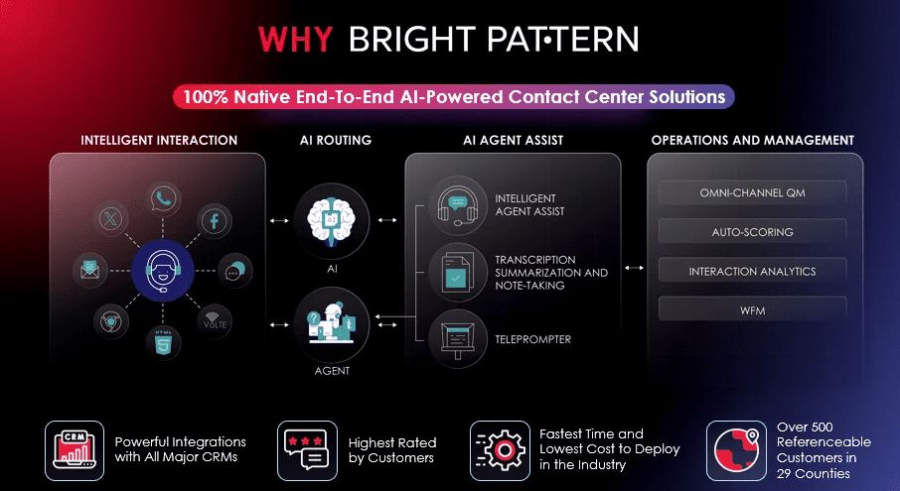
- AI virtual agents for self-service tasks like FAQs, order status, and appointment scheduling
- Intelligent routing to match customers with the best agent based on context, skills, and sentiment
- Omnichannel support across voice, chat, email, SMS, and messaging apps
- Real-time agent assistance with next-best-action recommendations
- Scalable, highly configurable workflows for enterprises
- Enterprise-grade security and compliance for regulated industries
Bright Pattern empowers businesses to deliver efficient, consistent, and human-centric experiences at scale.
2. Genesys Cloud CX
Genesys Cloud CX leverages AI to provide predictive engagement, intelligent routing, and customer journey analytics. Its strong omnichannel capabilities and automation make it ideal for organizations seeking actionable insights and seamless experiences.
3. NICE CXone
NICE CXone integrates AI across workforce optimization, automation, and analytics. Its real-time sentiment analysis and performance monitoring tools help improve agent effectiveness and enhance customer satisfaction.
4. Talkdesk AI
Talkdesk AI provides real-time agent support, automated workflows, and industry-specific solutions. Its fast deployment and seamless integration capabilities make it suitable for growing contact centers.
5. Amazon Connect
Amazon Connect uses AI services such as Amazon Lex and Contact Lens to provide speech recognition, sentiment analysis, and virtual agents, enabling scalable, cloud-native customer engagement.
6. Zendesk AI
Zendesk AI enhances support workflows with conversational bots, knowledge base suggestions, and AI-assisted responses, helping teams deliver faster, more accurate support.
7. Microsoft Dynamics 365 Customer Service
Microsoft Dynamics 365 integrates AI with CRM to deliver virtual agents, predictive insights, and real-time guidance, ideal for organizations within the Microsoft ecosystem.
8. Google Cloud Contact Center AI (CCAI)
Google CCAI provides AI-driven virtual agents, speech-to-text analytics, and real-time agent assist tools. Its flexible architecture supports organizations that need customizable AI solutions.
9. Salesforce Service Cloud + Einstein AI
Salesforce Einstein enhances Service Cloud with AI-powered case routing, predictive recommendations, and intelligent automation, making it an excellent choice for Salesforce-centric organizations.
10. Five9 Intelligent Cloud Contact Center
Five9’s AI includes virtual agents, smart IVR, and agent assist tools, enabling organizations to transition from traditional call centers to modern, AI-enhanced cloud contact centers.
Top benefits of AI for contact centers
Organizations adopt AI because it can make performance gains visible in the metrics leaders and customers care about most. Benefits often cluster into four categories: customer experience, agent experience, operational efficiency, and business intelligence, reflecting the power of ai powered contact center solutions in driving measurable results.
1) Faster resolutions and shorter wait times
AI can reduce friction before an agent even joins the conversation. For example, a chatbot can handle common questions (like order status, password resets, policy details, appointment scheduling) or collect key context (account identifiers, reason for contact, device type, error codes). That means customers spend less time repeating themselves and agents can start closer to the solution.
On live calls, agent assist can surface relevant knowledge and troubleshooting steps, helping reduce average handle time while maintaining quality. Summarization can also cut down after-call work, which is a direct lever for efficiency.
2) Higher consistency and quality across interactions
Humans are great at empathy and problem solving, but the same issue handled by different agents can yield different outcomes. AI helps standardize best practices by prompting agents with:
- Approved phrases and compliant disclosures
- Knowledge snippets that match the customer’s intent
- Step-by-step workflows and checklists
- Dynamic scripts that adapt based on what the customer says
This improves consistency without forcing conversations into a rigid script. The result is often fewer errors, fewer repeat contacts, and more predictable customer experiences.
3) Better agent experience and faster ramp time
Agent turnover and training time can be major constraints. AI can lighten cognitive load by finding answers quickly, drafting responses, and summarizing what happened so agents can focus on listening and problem solving.
In onboarding, AI-supported guidance helps new agents build confidence faster. Instead of memorizing complex policies or searching multiple systems, they can rely on context-aware suggestions during real conversations, accelerating time-to-proficiency.
4) More insight from every conversation
Contact centers generate a huge volume of unstructured data: transcripts, recordings, chat logs, and notes. AI analytics can turn that data into insights such as:
- Top drivers of contact (and how they trend over time)
- Emerging product or service issues
- Repeat-contact patterns and avoidable failure points
- Coaching needs by team, queue, or interaction type
- Customer sentiment signals and escalation triggers
These insights help contact center leaders collaborate with product, operations, and digital teams to reduce incoming volume through fixes upstream.
5) Scalable support across channels and languages
As customers move fluidly between voice, chat, email, and social channels, AI can support consistent intent detection, knowledge delivery, and summarization across channels. For organizations serving multiple regions, AI-assisted translation and multilingual intent classification can improve coverage and responsiveness, especially during peak periods.
High-impact AI use cases in contact centers
While AI can touch many parts of the operation, a few use cases typically produce outsized value. Choosing the right starting point depends on your contact reasons, data readiness, and KPIs.
AI chatbots for self-service (digital channels)
Chatbots can deliver immediate responses for common, low-complexity needs. The biggest wins usually come from:
- Answering FAQs from a controlled knowledge base
- Guided workflows (returns, cancellations, updates)
- Triage (collecting details before handoff)
- Status updates (order, delivery, case progress)
When designed well, bots help customers solve issues quickly, while preserving a clear path to an agent for complex or sensitive cases.
Voicebots and intelligent IVR modernization
Traditional IVR trees can feel slow and limiting. Voice AI can let customers speak naturally, then route or complete tasks based on the detected intent. This can reduce misroutes and shorten time-to-resolution by getting callers to the right destination faster.
Voice automation can also be effective for predictable transactions such as appointment confirmations, billing queries, and account updates, provided identity and authorization steps are handled appropriately.
Real-time agent assist and next-best action
Agent assist tools operate during live interactions to guide the agent moment-by-moment. Common features include:
- Real-time transcription for voice calls
- Suggested replies for chat and messaging
- Knowledge recommendations based on intent
- Next-best action prompts (troubleshooting steps, eligibility checks)
- Compliance cues (disclosures, verification reminders)
This use case is especially valuable in complex environments like technical support, healthcare administration, insurance, and financial services, where accuracy and completeness matter.
Automatic call summarization and dispositioning
After-call work can consume a surprising portion of an agent’s day. AI-generated summaries can accelerate documentation by producing consistent notes such as:
- Customer issue and context
- Actions taken
- Resolution outcome
- Follow-up steps and ownership
Summaries can also improve continuity when cases are handed off between teams, reducing the need for customers to repeat information.
Conversation analytics for quality, coaching, and compliance
Traditional quality assurance often reviews a small sample of interactions. AI-powered analytics can expand coverage by automatically tagging interactions, highlighting risk markers, and surfacing coaching opportunities at scale.
Examples of what AI can flag include:
- Missed verification steps
- Policy deviations
- Escalation risk signals
- Frequent hold times or dead air
- Sentiment shifts that suggest frustration
For coaching, analytics can identify top-performing behaviors and replicate them across teams through targeted training and playbooks.
Smarter routing and personalization
Routing decisions shape the entire experience. AI-enhanced routing can incorporate multiple inputs, such as:
- Intent and complexity
- Customer segment or priority tier
- Language and regional considerations
- Agent skills and certifications
- Current queue conditions and service-level targets
This helps get customers to the best-fit agent sooner, improving both customer satisfaction and first-contact resolution.
Where AI delivers measurable improvements (and which KPIs to watch)
To keep AI initiatives grounded, tie each use case to specific outcomes. Below is a practical KPI map that contact center leaders commonly use.
| AI capability | Typical operational impact | KPIs to track |
|---|---|---|
| Chatbots / self-service | Deflects repetitive contacts and speeds up simple resolutions | Containment rate, deflection rate, CSAT for bot journeys, drop-off rate |
| Agent assist | Faster answers and more consistent handling during live interactions | AHT, FCR, agent utilization, CSAT, QA scores |
| Call summarization | Less after-call work and more consistent documentation | ACW time, case rework, transfer rate, documentation completeness |
| Speech / text analytics | Improves coaching, identifies drivers of contact, reduces repeat issues | Repeat contact rate, escalation rate, QA coverage, top contact reasons |
| Intelligent routing | Better matching of customers to the right agents and queues | Transfer rate, FCR, time to answer, service level, abandonment rate |
One practical tip: establish a baseline for each KPI before rollout, then measure changes by queue, contact type, and channel. This helps isolate where AI is creating value and where processes may need refinement.
How AI improves the customer journey (before, during, and after contact)
Before the agent: smarter intake and faster triage
AI can streamline the first moments of a customer interaction by capturing intent and context. Done well, this means:
- Fewer menu options and fewer transfers
- Better self-service completion for common needs
- More complete context passed to agents on handoff
The result is a faster path to resolution and a more seamless experience across voice and digital channels.
During the interaction: real-time guidance and fewer mistakes
In live conversations, the agent must listen, search knowledge, follow policies, document details, and keep rapport. AI supports the agent by surfacing relevant information in real time and reducing the amount of manual searching and switching between systems.
For customers, this often translates into faster answers, fewer holds, and more confidence that the solution is correct.
After the interaction: better follow-through and continuous improvement
Post-contact, AI summaries and analytics improve continuity and reduce rework. Meanwhile, trend analysis helps leaders spot systemic issues that create avoidable volume. Over time, that creates a compounding benefit: fewer inbound contacts for preventable reasons, and more capacity for high-value conversations.
Examples of AI success stories (realistic scenarios)
While outcomes vary by industry and execution, the most compelling AI wins in contact centers often look like these scenario-based stories:
Scenario 1: Reducing peak-time pressure with self-service
A retail support team experiences seasonal spikes in “Where is my order?” contacts. By deploying a chatbot that handles order status lookups and proactive guidance (delivery windows, carrier updates, common exceptions), the team reduces the load on live agents during peak times. Agents then focus on exceptions and complex cases, improving response times where human support is most needed.
Scenario 2: Shortening ramp time for new agents
A technical support center with frequent product updates equips new agents with real-time agent assist that surfaces troubleshooting steps based on the customer’s described symptoms. The tool reduces time spent searching internal resources and helps standardize resolution paths. New agents become productive faster, and customers receive more consistent support.
Scenario 3: Improving quality coverage beyond sampled QA
A regulated service environment expands its quality program using conversation analytics to flag interactions that include high-risk topics and required disclosures. Supervisors prioritize coaching time where it matters most, increasing the effectiveness of QA and improving consistency across teams.
Key components of a strong AI implementation
The best contact center AI programs are built on clarity, data, and operations alignment. These components often determine whether AI becomes a measurable advantage or a scattered set of features.
1) A clear use-case roadmap
Start with 2 to 4 high-impact use cases that map to business goals. Examples include reducing after-call work, increasing containment for top intents, or improving first-contact resolution in a specific queue.
Then define:
- Which contact types are in scope
- Which channels (voice, chat, email, messaging)
- What “success” means in KPIs
- Who owns the process and ongoing optimization
2) Knowledge management that AI can rely on
AI outputs are only as dependable as the information behind them. A strong knowledge foundation typically includes:
- Current, approved articles and policies
- Clear ownership and review cycles
- Consistent taxonomy and tagging
- Content written for quick retrieval and clarity
This benefits not just AI, but also human agents and self-service experiences.
3) Human-in-the-loop operational design
To keep performance high, leading teams treat AI as a partner that is monitored and improved. That includes:
- Reviewing bot conversations to refine intents and workflows
- Auditing suggested answers for accuracy and tone
- Capturing agent feedback to improve relevance
- Creating escalation paths for complex or sensitive requests
4) Governance, privacy, and compliance alignment
Contact centers often handle sensitive personal data. AI programs should align with internal policies and applicable regulations, focusing on:
- Data minimization (collect only what’s needed)
- Access controls and role-based permissions
- Retention rules for transcripts and recordings
- Appropriate redaction for sensitive fields when required
Well-designed governance supports trust and sustainable scale.
AI rollout plan: a practical phased approach
A phased rollout reduces risk and creates momentum through visible wins.
Phase 1: Diagnose and prioritize
- Identify top contact drivers and pain points
- Baseline current KPIs (AHT, FCR, CSAT, ACW, transfer rate)
- Select one channel and one queue for an initial pilot
- Define success metrics and measurement approach
Phase 2: Pilot with tight feedback loops
- Deploy to a small group of agents or a limited set of intents
- Capture agent and customer feedback
- Review transcripts and outcomes weekly
- Tune knowledge, routing logic, and workflows
Phase 3: Expand and standardize
- Scale to additional queues, languages, and channels
- Standardize QA scorecards and coaching workflows that use AI insights
- Operationalize governance and change management
- Report outcomes in a consistent KPI dashboard
Phase 4: Optimize for compounding returns
- Use analytics to reduce avoidable contacts upstream
- Refine personalization and routing strategies
- Continuously improve self-service containment and handoff experience
- Train and coach agents based on interaction-level insights
How to choose the right AI capabilities for your contact center
Instead of starting with features, start with fit. The right AI capabilities depend on the reality of your operation: your channels, your contact reasons, and your appetite for change.
Questions to guide your selection
- Which interactions are highest volume? These often deliver fast ROI through automation and faster handling.
- Which interactions are highest risk or most complex? These benefit from agent assist, guided workflows, and analytics-driven coaching.
- Where is time being lost today? Common culprits include knowledge search, after-call notes, and transfers.
- Do we have reliable knowledge content? If not, prioritize knowledge management improvements alongside AI.
- How will we measure success? Define KPI targets and a review cadence before you launch.
When those questions are answered, it becomes easier to identify the best first use case and build a roadmap that scales.
The bottom line: AI can turn your contact center into a growth engine
AI for contact centers is now a practical toolset for improving what customers feel and what operations measure: faster resolutions, stronger quality, happier agents, and better insight into what drives demand. With the right roadmap and a commitment to continuous improvement, AI can help your contact center move from reactive support to proactive value creation.
If you focus on high-impact use cases, strong knowledge foundations, and measurable KPIs, you can unlock benefits that compound over time: fewer avoidable contacts, more consistent experiences, and more capacity for the conversations that truly require a human touch.
Quick checklist: getting started with AI in your contact center
- Pick 2 to 4 priority use cases tied to clear KPIs
- Baseline AHT, FCR, CSAT, ACW, transfers, and top contact drivers
- Strengthen knowledge content and ownership
- Run a pilot with tight feedback loops
- Operationalize governance for data handling and compliance
- Scale in phases and keep optimizing based on analytics
With this approach, AI becomes more than a feature. It becomes a repeatable way to deliver better service, at speed, and at scale.
